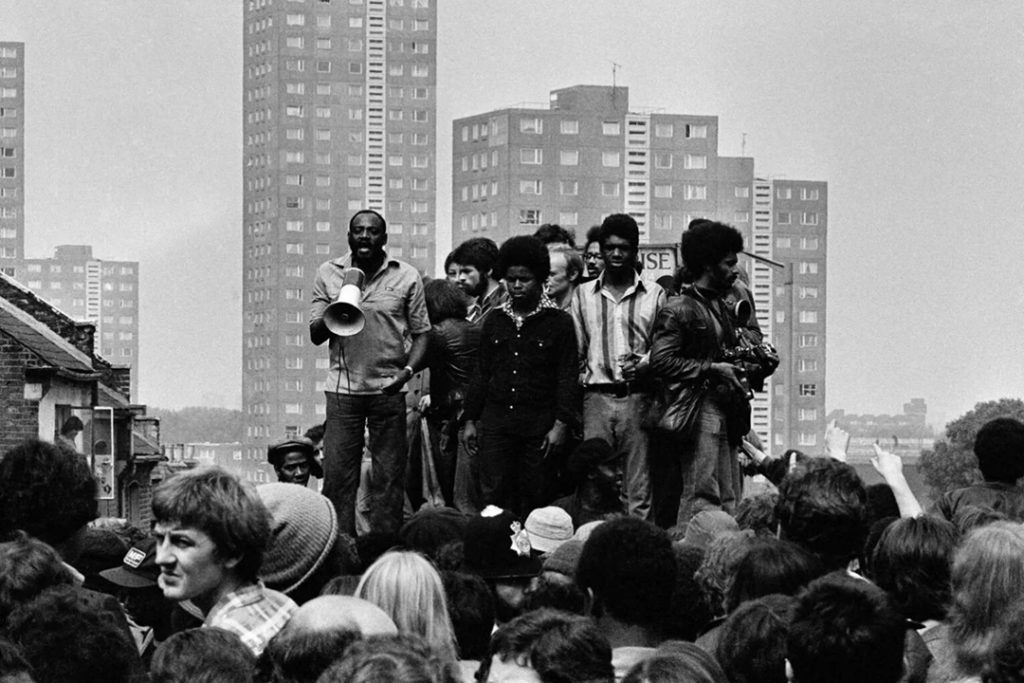
Darcus Howe and Lewisham
Darcus Howe was a civil rights activist who campaigned for racial justice and police accountability. He holds an especially important place in Lewisham history because of the prominent role he played in important local events, notably the Battle of Lewisham in 1977 and the Black People’s Day of Action in 1981 following the New Cross Fire.
Leighton Rhett Radford Howe was born on 26 February 1943 in Moruga, Trinidad, then a British colony in the West Indies. He was the son of Cipriani Howe, an Anglican priest, and his wife Lucille (née Rudder), a teacher.
In 1961, at the age of 18, after finishing school, Howe moved to England. Howe had initially planned to study law in England but found himself more drawn to journalism. He was mentored by his cousin, the radical intellectual C. L. R. James, who was also living in Britain.
After a period of travelling internationally, in the late 1960s, Howe became a member of the British Black Panther Movement, a black power organisation that fought for the rights of black people and other minorities. It was around this time he also formally adopted the name “Darcus.”
In 1970, Howe was back in England and working in the Mangrove Restaurant in Notting Hill. The Mangrove was a popular meeting place for black people and was regularly raided by the police. Howe took part in protests against this police harassment, leading to his arrest alongside eight other people for inciting riot. Howe represented himself throughout the 55 day trial of the ‘Mangrove Nine’ at the Old Bailey, which resulted in acquittals for the most serious charges. Also, for the first time in history there was judicial acknowledgement of police racism.
From 1973 to 1985, Howe was editor of the magazine Race Today. From the early 1980s he began a broadcasting career, making television programmes, predominantly about racial issues. He also wrote for a number of leading newspapers. This greatly increased his public reach.
Howe identified most with the black working classes. He believed strongly in in the power of black organising and sought to unite radicalism with reason. His work with the black power movement and as a journalist took him all over the world. However, he played an important role in at least two important events in Lewisham.
The Battle of Lewisham took place on 13 August 1977. It happened when 500 members of the far-right National Front attempted to march from New Cross to Lewisham. They were met by counter-demonstrations of approximately 4,000 people protesting racism and fascism. Howe was a prominent speaker at this Anti-National Front Demonstration.
In 1981 Howe organised the Black People’s Day of Action following the New Cross Fire. Thirteen young black people had died in the New Cross Fire, which was a suspected racist attack. However, this event was met with indifference from politicians, the mainstream press and the police. More than 20,000 people marched through London in protest on 2 March 1981.
Howe died at his home in Streatham on 1 April 2017.
The Bloomsbury Academic book Darcus Howe: a Political Biography by Robin Bunce and Paul Field is open access.
Our favourite Darkus Howe quote is:
“Come what may, we are here to stay.”
This phrase emerged from Asian anti-racist campaigning in the East End of London. Darcus Howe adopted the slogan when organising The Black People’s Day of Action march against racism and police inaction held in London on 2 March 1981 following the New Cross house fire.