Eleanor Marx’s Love of Lewisham
Jenny Julia Eleanor Marx was born in London on 16 January 1855, the youngest daughter of Karl Marx and his wife Jenny von Westphalen. She was known as Eleanor, and, within the family, as “Tussy.” Eleanor’s father, Karl Marx, was a German philosopher and revolutionary socialist whose work has had a profound impact on the world. However, the family lived in often difficult financial circumstances. Eleanor took a keen interest in politics from a young age, initially becoming her father’s secretary at age sixteen. Eleanor’s commitment to socialism was lifelong and she continued to work tirelessly as a socialist activist after the death of her father in 1883.
In 1884 Eleanor founded the Socialist League alongside William Morris, Ernest Belfort Bax and Edward Aveling. The last of these men, Edward Aveling, had become Eleanor’s partner in 1883. They could not marry, as Aveling was separated from his wife, but they lived together as man and wife for the rest of her life, and Eleanor took on the name Eleanor Marx Aveling.
Eleanor was a prolific writer on politics throughout her life. She also undertook the translation of many important texts. She was tireless in her support of workers and became involved in the Women’s Trade Union League. She supported numerous strikes in London, including the Bryant & May strike of 1888 and the London Dock and Silvertown Strikes of 1889. She was an organiser for the Gasworkers’ Union. She recognised and spoke out about how the bourgeois women’s movement often failed to address the needs of working-class women. She wrote of the women’s trade union movement in England “We are not women arrayed in struggle against men but workers who are in struggle against the exploiters.”
Eleanor also operated internationally. In 1885 she helped organise the International Socialist Congress in Paris. In 1886 she toured the United States with Aveling and the German socialist Wilhelm Liebknecht, raising money for the Social Democratic Party of Germany.
Eleanor was a speaker at the London demonstration of 13 November 1887. This was a protest march about unemployment and the Irish Coercion Acts. This event was violently suppressed by the Metropolitan Police. Hence it became known as Bloody Sunday. Afterwards Eleanor wrote a report on the brutal treatment of women by police.
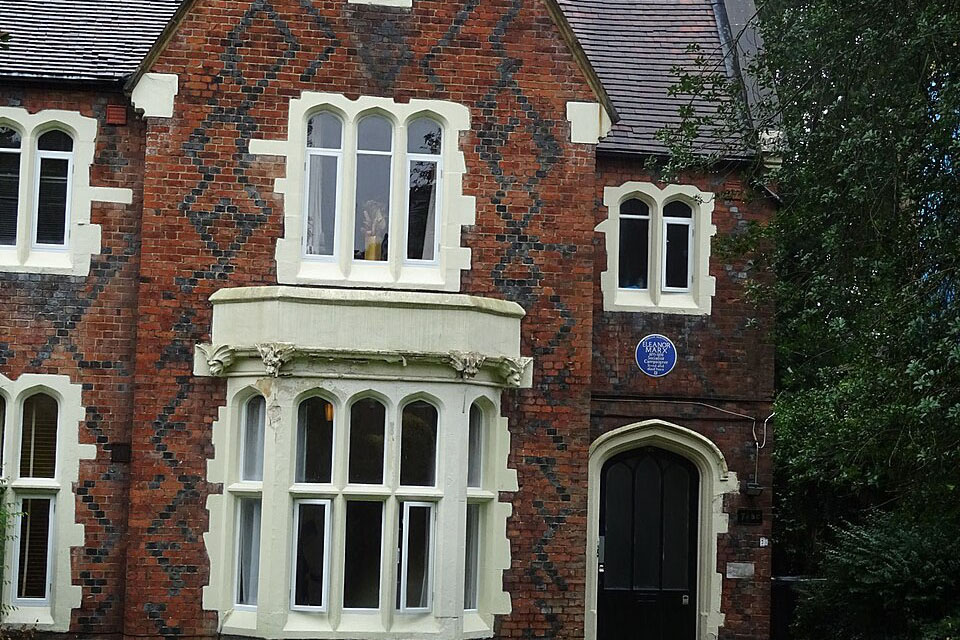
In 1895 the London-based German socialist, Friedrich Engels, died. Engels had collaborated very closely with Karl Marx and continued working with his daughters after his death. Engels left money to Eleanor and her surviving sister. This was the first time in Eleanor’s life that she had some money. Eleanor chose to buy a home in Sydenham, number 7 Jew’s Walk. She adored this home and garden. She became involved in the local community, singing with the local socialist choir, which she affectionally called her ‘Dear Lewishamers.’ However, her happiness was not complete and lasting. Notably, her life partner, Edward Aveling secretly married another woman in 1897, leaving her bereft. Eleanor died by suicide on 31 March 1898 having swallowed prussic acid. She was just forty-three years old. As it happens her death was certified by local doctor, Henry Shackleton, who was father of Ernest Shackleton, who went on to become a famous Antarctic explorer.
Our favourite Eleanor Marx quote is:
“We are not women arrayed in struggle against men but workers who are in struggle against the exploiters.”