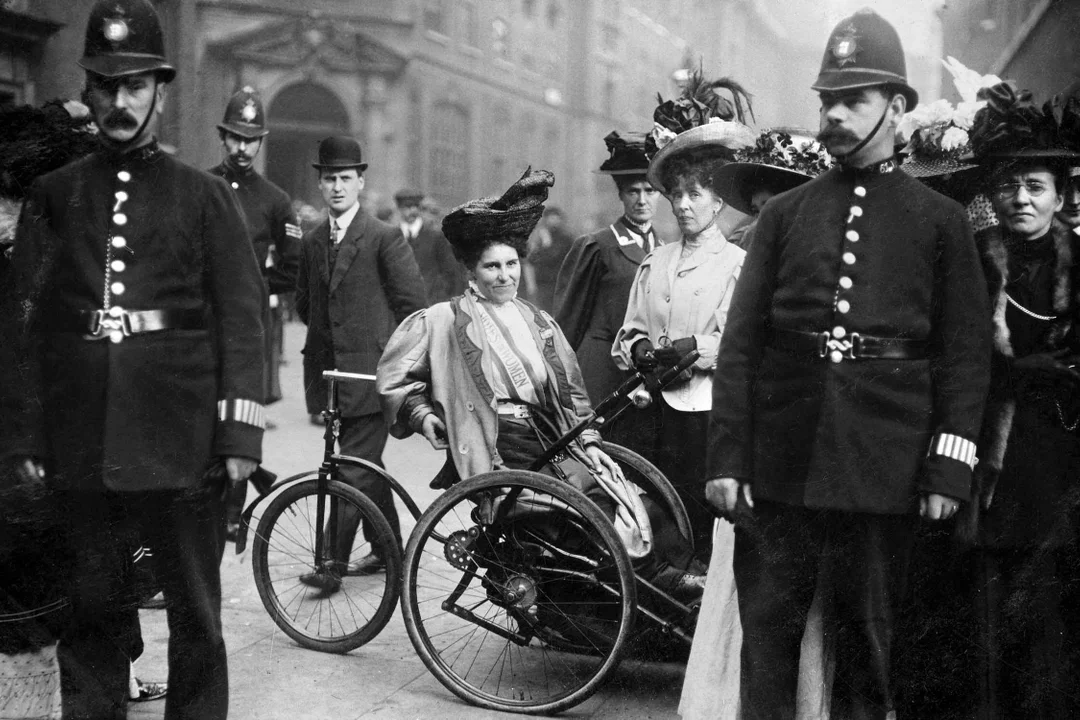
Rosa May Billinghurst was born at 35 Granville Park in Lewisham on 31 May 1875, the daughter of Henry Farncombe Billinghurst, a banker, and his wife Rosa Ann (née Brinsmead). She was generally known as “May.”
The Billinghurst family appear to have been comfortably well-off. At the time of the 1881, 1891 and 1901 Censuses they remained living at 35 Granville Park. Notably they always had live in servants. However, whilst May seems to have belonged to a privileged family, as a child she contracted polio, which left her paralysed. To get around she had to use crutches or a wheelchair.
As a young woman May took up social work in connection with the Greenwich Workhouse, taught Sunday School and was involved in the Band of Hope temperance movement for children. She also became a very active member of the Women’s Social and Political Union (WSPU). This was a women-only militant organisation campaigning for women’s suffrage. Founded in 1903 by Emmeline Pankhurst and her daughter Christabel, from 1906 they were commonly known simply as the suffragettes.
May took part in the 1910 Black Friday demonstration, in which 300 women marched to the Houses of Parliament as part of their campaign to secure the vote for women. This day earned its ominous name because of the violence perpetrated against the women protesters, both by the Metropolitan Police and by male bystanders. May, who was one of those arrested that day, used a distinctive modified tricycle to get around at this stage in her life. This led to her becoming popularly known as the “cripple suffragette.” She was arrested several more times in the coming years and spent time in Holloway Prison. By the time of the 1911 Census, the Billinghurst family had moved from Granville Park to nearby Oakcroft Road, but May was not recorded. This is likely because she joined that year’s suffragette boycott of the Census.
From 1911 to 1914 suffragettes were known for their ‘Pillar Box’ campaign of attacks on the postal system. On 21 December 1912 the Sydenham, Forest Hill & Penge Gazette reported that by then there had been something like thirty pillar box outrages in the Lewisham district. As reported, three women had now been arrested and appeared in police court, in relation to such an outrage, after a group of Salvation Army carol singers had seen them acting suspiciously and reported them. The three women were May Billinghurst of Oakcroft Road, Lewisham, Grace Michell of St. Stephen’s Road, Lewisham, and Louisa Gay of Broadway, Brighton Road, in Croydon.
On 7 January 1913, May Billinghurst and Grace Michell were found guilty of damage to property, namely a Post Office letter box situated at Aberdeen Terrace, following a trial at the Old Bailey. May received a prison sentence. To try to garner more publicity May had represented herself. An impassioned speech she gave was re-printed in The Suffragette newspaper:
GENTLEMEN OF THE JURY, — I will as you to allow me to explain some of the circumstances which have let me to be standing before you to-day in this dock, to fight for the liberation of women that they may be free to take their part in legislation for the good of our country.
The first time I realised the pressing need for this reform was ten years ago, when I was working among the inmates of a workhouse. There I learnt the sad life-histories of the people who had been driven, through the imperfect economic laws of the country, the sweated condition of women, to end their days sitting listlessly and hopelessly in the workhouse waiting for death. My heart ached, and I thought surely if women were consulted in the management of the State, happier and better conditions must exist for hardworking, sweated lives such as these, many of whom had beautiful characters.
I also taught in a Sunday-school and Band of Hope, and my love for the children took me to their homes.
In these slum homes I became acquainted with such sorrow and suffering borne by the women that I could not sit comfortably at home and think of it. Many of these poor homes could not have been kept together without the mothers, who were their mainstay, and yet were not given the protection of the vote. Some husbands were drunkards, some openly unfaithful. Some deserted their wives and children, and many beat them, and it was gradually unfolded to me that the unequal laws which mad women appear inferior to men were the main cause of these evils. I found that the man-made laws of marriage, parentage, and divorce placed women in every way in a condition of slavery, and were as harmful to men, by giving them power to be tyrants, as they were harmful to the women. At this time I also became acquainted with the rescue work in the streets of London through my sister, who was a rescue worker. I cannot speak of all the horrors that were revealed to me in this work. It was quite a common occurrence for little girls of 12 and 13 years to be brought to the Rescue Home because they were about to become mothers. The men who had ruined these children’s lives almost always escaped. Sometimes, however, a man was brought o account, and then the punishment was so inadequate to the fearful crime.
I felt then that for the protection of the young, women must without delay find some means to get a voice not only in the making of the laws of the country, but in the administering of the laws also.
At this time I resigned from the Women’s Liberal Association, seeing clearly that it was Votes for Women that must be worked for, and it was that the country needed to put it on the right road.
I tried to find a Society which was working for the vote, and I heard that there were many good and high-souled women — such as Mrs. Fawcett, Mrs. Pankhurst, and Mrs. Despard, Mrs. W. Elmy, and others — who had been working for forty years to educate the country to the great need of the enfranchisement of women by a quiet and patient system of lobbying Members of parliament and writing petitions. It surprised me that, in spite of the work these good women were doing, the subject which was least though of or talked about in the country at large was the subject of “Votes for Women.” It was purely an academic question, and had not entered into practical politics.
I wondered how the public would ever be made to think about it, and think quickly before any more lives were wasted and mistakes made.
In the midst of the hopelessness of it all, Christabel Pankhurst sounded the war note of militancy, and was imprisoned for her boldness. But the note had been sounded, and the result was that the subject of “votes for Women” was on every tongue, and people had been roused to think at last.
Now, as you know, for seven long years the army of the Women’s Social and Political Union have carried on the fight against the oppression of women, under the splendid leadership of Mrs. and Miss Pankhurst and Mrs. Pethick-Lawrence, the women of the Union ready always to suffer imprisonment and torture to their own bodies, and to conduct their battle so as to jeopardise no other human lives or limbs.
This is a woman’s war, in which we hold human life dear ad property cheap, and if one has to be sacrificed for the other, then we say let property be destroyed and the human life be preserved. Let the panes of glass be broken and envelopes smudged. Attack ma’s god of property if that is the last resource to rouse him to think and to act on behalf of the oppressed women of his country, to make men realise that pressure must be brought to bear upon the Government in order that a Bill be passed this Session giving women the vote.
I should like to say here to the counsel for the prosecution that he could convey as message to the Postmaster-General as to the one and only way to stop the raid on pillar-boxes, which is for him (the Postmaster-General) to see to it that at Government measure to enfranchise women is brought in without delay.
The guilt lies on the shoulders of the Government for delaying the measure, not on the women who continue to fight for the protection of the weak and the oppressed.
In our union are women doctors, nurses, inspectors, teachers — women in almost every branch of industry and station of life. We are not hooligans seeking to destroy, but we mean to wake the public mind from its apathy, and to make our cause the burning question of the day, so that something shall be done for women.
Gentlemen, I have stated a few facts of my life to show you why I am standing in the dock to-day pleading “Not Guild.” I am fighting a righteous battle with a high motive.
You may think me guilty; I may be imprisoned. In that case I shall adopt the hunger strike as a protest against imprisonment being given to women instead of the justice they demand.
The Government may further maim my crippled body by the torture of forcible feeding, as they are torturing weak women in prison to-day. They may even kill me in the process, for I am not strong, but they cannot take away my freedom of spirit or my determination to fight this good fight to the end.
If my body should be injured, I hope the kindness and sense of justice lying latent in most Englishmen’s hearts will be roused, and that they will realise their responsibility to their country-women, and will rise in a body and say to the Government, “The oppression of women must cease. We, the men of England, demand that a bill be passed for the enfranchisement of women without any more delay.
I cannot understand why no member of my sex is even present to witness our trial in this public court.
This warfare is a political necessity.
The members of the Government are the culprits, not I.
May, together with other suffragettes, subsequently went on hunger strike in prison, and was force-fed. She continued her activism, only returning to a quiet life following the passing of the Parliament (Qualification of Women) Act 1918, which gave some women the vote. She died on 29 July 1953.
Our favourite Rosa May Billinghurst quote:
“We are not hooligans seeking to destroy, but we mean to wake the public mind from its apathy.”